
%20(8).jpg)
Most brands spend more time debating their shoot location than they do thinking about whether they need one at all.
In-studio vs on-location video production is one of the first decisions you will make on any project, and it shapes everything downstream: budget, logistics, timeline, and what the final video actually looks like. Get it right and production runs clean. Get it wrong and you spend the shoot day fighting the environment instead of using it.
Both formats have a place. Here is how we think through the decision at STMNT.
Quick Answer: In-Studio vs On-Location Video Production
Choose studio production if:
- You need consistent lighting across multiple subjects or shoot days
- Clean audio is non-negotiable
- You have multiple interview subjects who need to look visually cohesive
- You are producing multiple deliverables from one shoot day
- You want full creative control over the environment
Choose on-location production if:
- The environment is part of the story
- Authenticity in the setting matters: culture, recruiting, documentary work
- You need workplace or real-world footage to build trust
- The location itself signals something about your brand
The real question is not which option looks better. It is whether the location needs to be in the frame, or whether the content needs to be in the frame.
In-Studio vs On-Location: A Direct Comparison
In-Studio Video Production: When Control Is the Point
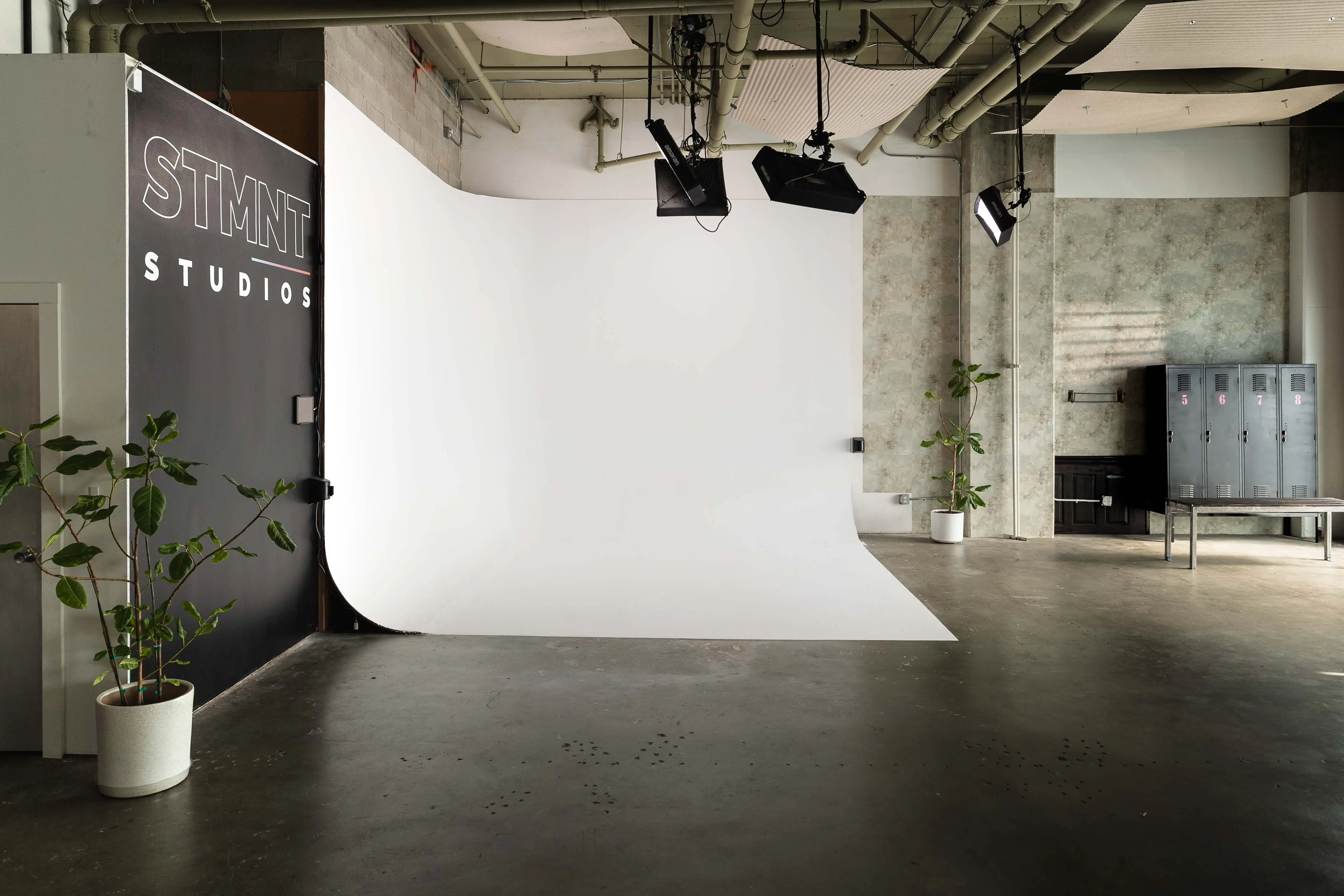
Shooting in a studio does not mean shooting against a grey wall with a ring light. It means building an environment from scratch, one where every decision about lighting, set design, background, and sound is made intentionally for the content you are producing.
That control is the whole point. In a studio, the camera is not competing with a door that keeps opening, street noise that spikes every ten minutes, or a window that changes color temperature as clouds move through. You set the conditions once and they hold for the entire shoot day.
Some of the strongest corporate video production work we have done came from custom studio builds that looked nothing like a traditional studio. For Plaid's Fall Release campaign, we built a set using a green curtain, slat wall, and warm natural lighting: a visual system that held five different speakers together across two shoot days and became the backbone of fourteen deliverables. There was no real location involved. The set was designed to serve the content, and it did.
Studio video production works best when:
- You have multiple speakers and need visual consistency across all of them
- The content is interview-led and the environment should feel considered, not incidental
- You are producing a high volume of assets in a short time and need a repeatable setup
- Sound quality is non-negotiable
- You want full control and cannot afford variables on the day
On-Location Video Production: When the Place Does the Work
Location shooting earns its cost when the environment is doing work that no set build can replicate. The energy of a real office, the texture of a specific neighborhood, the visual proof that your team exists in the real world: those things are hard to fake, and you should not try.
The many campaigns we have produced for Cost Plus World Market are good examples of on-location production working the way it is supposed to. Over the course of several campaigns, we shot across multiple real homes, with the client bringing in their own decor and models for each location. The lived-in quality of those spaces was the whole point. A studio build would have produced something that looked like a catalog shoot. Shooting on location produced something that looked like someone's actual home, which is exactly what the content needed to feel.
Cost Plus World Market Christmas | Cost Plus World Market Furniture
On-location video production works best when:
- The environment is part of the story and the audience needs to see it
- Authenticity in the setting matters: recruiting content, culture videos, documentary-style work
- You need spatial scale that a studio cannot provide
- The location carries a brand association that benefits you
The Tradeoffs Most People Underestimate in In-Studio vs On-Location Video Production
Cost. Studios are often assumed to be the expensive choice. They are not, once you factor in everything a location shoot requires: permits, travel, location fees, the time lost moving equipment, and overtime when a space is only available until a certain hour. A well-run studio day can be faster and cheaper than an on-location day that looks simpler on paper.
Sound. Location audio is the single biggest source of post-production problems on most video projects. HVAC systems, street noise, other people in the building: these are expensive to fix in post and sometimes impossible to fix cleanly. In a studio, you control the acoustic environment from the start.
Variables. On location, something will go wrong that nobody predicted. The light will shift. The room will be warmer than expected. A neighboring business will start a renovation at 10am. These are not reasons to avoid location work. They are reasons to go in with eyes open and schedule accordingly.
Creative ceiling. This one cuts the other way. A studio gives you control but requires a stronger creative brief to make the most of it. An empty studio with no clear visual concept produces content that looks like it was shot in an empty studio. The environment does not carry you the way a compelling location can. You have to design your way into it.
How to Actually Decide: Studio vs. Location
Ask one question before anything else: does the location need to be in the frame, or does the content need to be in the frame?
If the location is the point, if you are filming in a space that signals something about your brand, in an environment your audience needs to see, shoot on location. If the environment is just a container for the content and consistency matters more than context, a studio will almost always serve you better.
Many brand video production in San Francisco projects use both: interviews filmed in a controlled studio environment alongside b-roll captured on location. Blending the two formats is often the right call when a project needs to feel both polished and real.
When you are not sure, talk to your production team before you commit. The right answer depends on your deliverables, your timeline, and what the video is actually trying to do. If they give you the same answer regardless of the brief, that is worth paying attention to.
The Format Most People Overlook
Studio or location, there is also a third option worth knowing: no shoot day at all. Motion graphics, stock footage, screen recordings, kinetic typography. Some of the most effective video work skips the camera entirely.
We produced a brand film for Plaid's mortgage vertical using stock footage, motion graphics, and sound design. No location. No talent. No shoot day. The brief called for a screen-life narrative, and the most honest way to tell that story was to put the viewer directly inside the digital experience. The format followed the brief, not the other way around.
Not every project needs a camera. If your message is the point and the medium is just the delivery mechanism, do not let format assumptions drive the production decision.
FAQ: In-Studio vs On-Location Video Production
Is studio video production cheaper than on-location production?
Often, yes, but it depends on the scope. Studio days are more predictable: you set your conditions once and they hold. On-location production adds variables that translate directly into cost: permits, travel, location fees, time lost to setup, and unexpected overtime when things run long. For interview-heavy projects, a studio day is frequently the more efficient and cost-effective choice.
When should you shoot video on location?
When the setting itself carries meaning that a studio cannot replicate. Recruiting and culture content, documentary-style brand films, and productions where the environment signals something about your company all benefit from real-world locations. If the audience needs to see the place, shoot there. If they do not, a studio will serve you better.
Can you combine studio and on-location footage in one video?
Yes, and it is often the right move. Interview-led content typically works best in a controlled studio environment, while supporting footage, b-roll, product shots, and environment establishes can be captured on location. Blending both gives you the consistency of a studio format with the visual texture of real-world footage.
Which is better for brand video production?
It depends on what the brand needs to communicate. If clarity, consistency, and production quality are the priority, studio. If authenticity, context, and environment are the story, on location. The best decisions come from matching the format to the brief, not defaulting to whichever option sounds more impressive.
What should I ask a video production company before deciding?
Ask them what format they recommend based on your deliverable list and timeline, not based on what they find easiest to produce. A production partner worth working with will tell you when on-location shooting is worth the added complexity and when a studio build will outperform it. If they default to one answer regardless of the brief, that is a red flag.
If you are working through format decisions for an upcoming project and want a direct read on what makes sense for your brief, start a project with us. We scope productions across studio, location, and format-flexible approaches based on what the work requires, not what the format assumes.

